
1.
8, 9, 11, 12, 13, 15, 15, 19, 20, 43
a) Quintiles
1st: 8 & 9
2nd: 11 & 12
3rd: 13 & 15
4th: 15 & 19
5th: 20 & 43
b) 5 equal intervals ( (43 – 8) / 5 = 7 )
1: 8 – 15
2: 15 – 22
3: 22 – 29
4: 29 – 36
5: 36 – 43
2.
a)
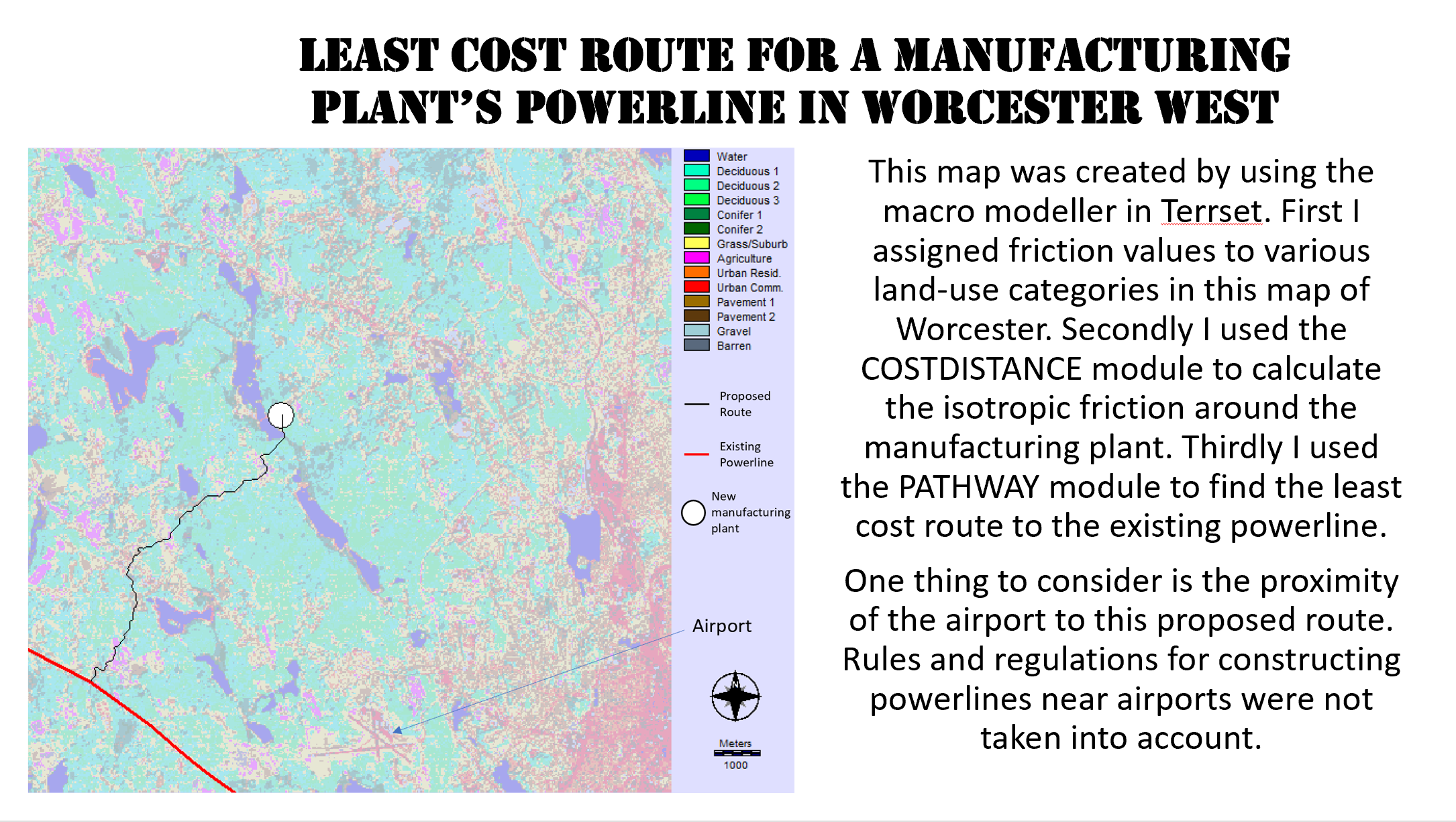
Isotropic friction occurs when moving from one point to another. This friction can result when movement is impeded upon by physical barriers or from the loss of energy/fuel. An example of this would be driving a car on different types of road: a sports car will encounter much less friction taking a well paved highway road versus taking a dirt road with potholes.
Anisotropic friction comes into effect when the direction of movement is related to the amount of friction exerted. An example of this would be swimming in a river: going towards the river flow will cost more energy than going with the river flow.
b)
The airport is in the South portion of the Worcester West map. For safety reasons the airport may not allow a power-line to be built within a specified radius of the airport. This makes it so that the airport is a physical and legal barrier to this construction project. I would create a buffer region around the airport and in the cost-distance model assign this area a friction value of 1000.
c)
3.
a)
Regression is the process of examining the relationship between an independent and dependent variable. By using the REGRESS module we can derive an equation for the correlation of the variables so we can perform map algebra.
An example: We want to see the relationship between precipitation and growth of wheat in an area. We say that rainfall (mm) is our independent variable and wheat yield (km*m^-2) is our dependent variable. We use REGRESS and see that correlation coefficient is close to +1.0 so we know this is a strong positive relationship.
b)
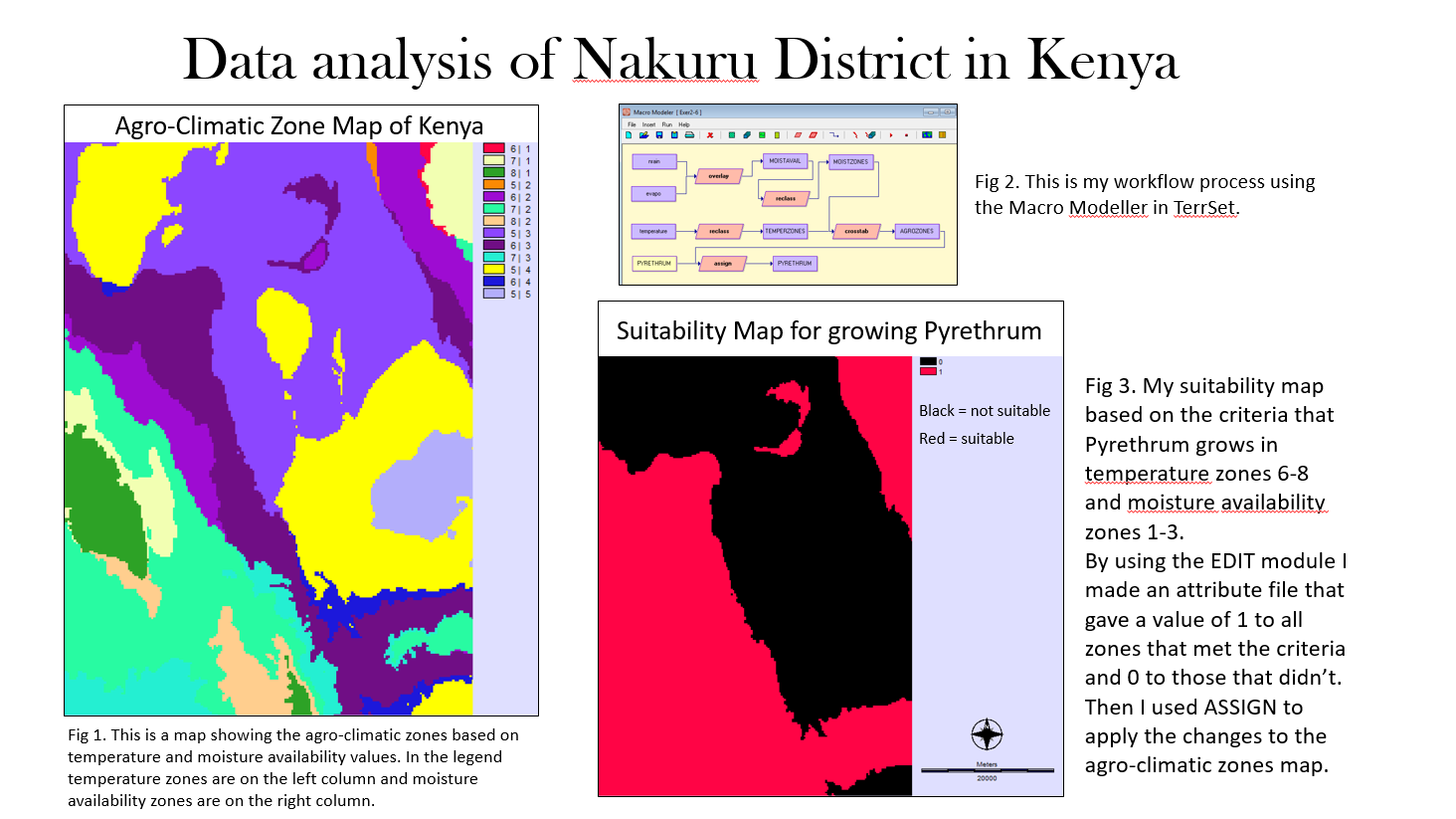
We use the REGRESS module in this exercise to find the equation between our elevation and temperature values. By doing this we were able to convert our relief map into a temperature map.
c)
The independent variable is elevation in this case because it is the variable that we are manipulating and the dependent variable is temperature because it is the one we are measuring. In this case we want to measure temperature values so it becomes our Y and this is why it has to be our dependent variable.
d)
Moisture availability is a function of annual rainfall divided by potential evaporation. The operation ratio is used to divide these, and we used the one with zero option because we don’t want to get an error if the potential evaporation value is zero.
e)